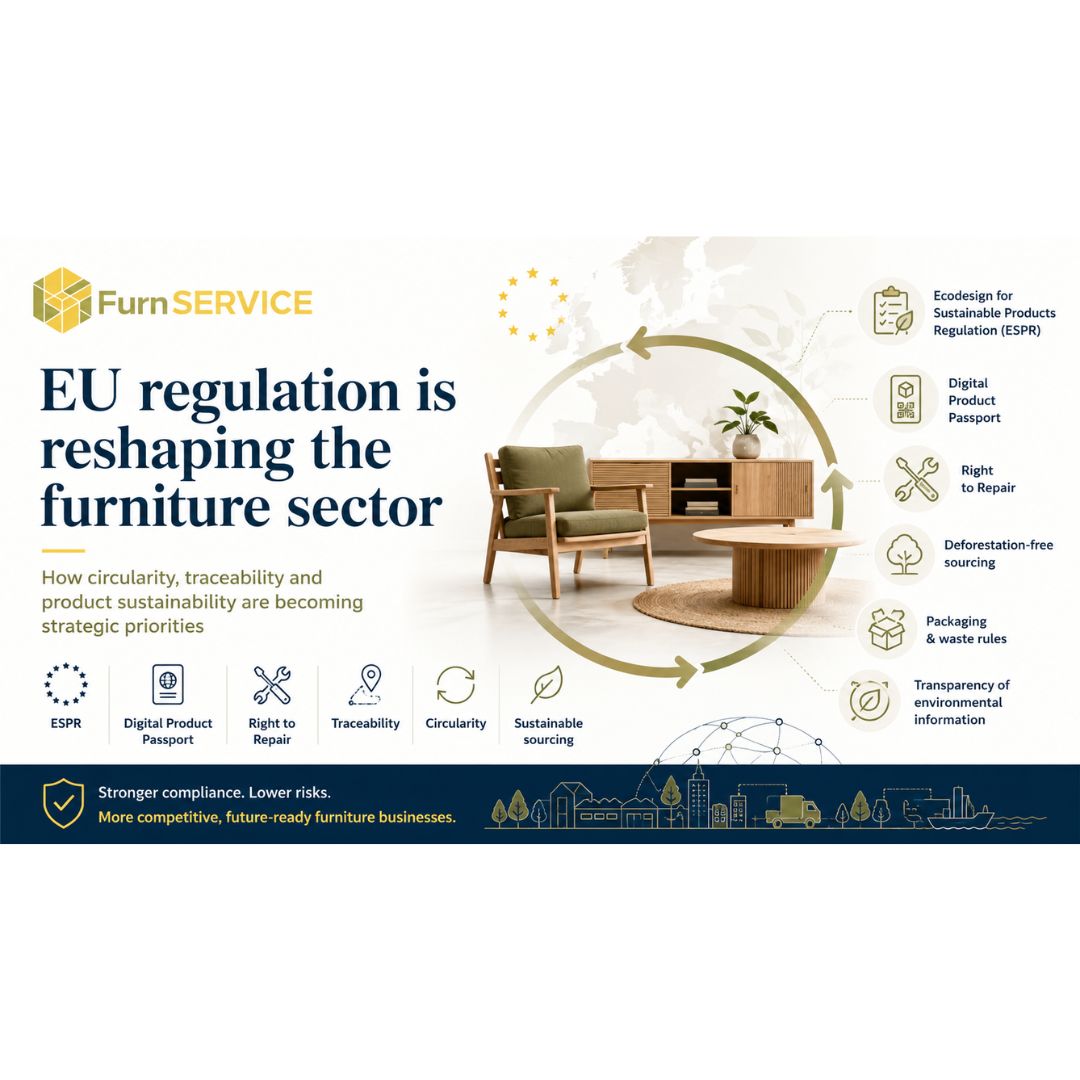
The FurnSERVICE Guide is taking shape, starting from a key question for the European furniture sector: how can companies prepare for a regulatory framework that is increasingly oriented towards circularity, traceability and product sustainability?
The first part of the Guide focuses on the evolving European policy landscape and explains why regulation should no longer be seen only as a compliance issue. For furniture companies, new EU rules are progressively becoming a strategic driver for innovation, competitiveness and business model transformation.
The European Green Deal, the Circular Economy Action Plan and the new Ecodesign for Sustainable Products Regulation (ESPR) are setting a clear direction: products will need to be more durable, repairable, recyclable, traceable and supported by reliable environmental information. Furniture, identified as a priority product group under the ESPR Working Plan, is directly involved in this transition.
One of the most important changes will be the introduction of the Digital Product Passport, which is expected to become a key tool for collecting and sharing information on materials, components, repairability, recycled content, substances, environmental performance and end-of-life options. For companies, this means that product data, supplier information and traceability systems will become increasingly important.
The Guide also explores other regulatory developments that are highly relevant for the sector, including the EU Deforestation Regulation, the Right to Repair Directive, rules on green claims and consumer information, the Packaging and Packaging Waste Regulation, Green Public Procurement criteria and the growing role of sustainable finance and EU Taxonomy-related activities.
Taken together, these initiatives show that the circular economy is moving from voluntary commitment to a more structured market framework. Companies will be asked to demonstrate not only what they produce, but how products are designed, sourced, used, maintained, recovered and communicated.
For the furniture industry, this transition brings challenges: more complex data management, new requirements across the supply chain, the need for clearer environmental claims and greater attention to repair, reuse and end-of-life strategies. At the same time, it opens up concrete opportunities for companies that anticipate change.
By preparing early, furniture businesses can strengthen their resilience, reduce exposure to material risks, improve customer trust, access new markets and develop service-based models linked to maintenance, refurbishment, take-back, reuse and Product-as-a-Service solutions.
The first section of the FurnSERVICE Guide will therefore provide companies with an accessible overview of the regulatory context, helping them understand how different EU initiatives connect and why they matter for future business decisions.
The full Guide will be available in Autumn 2026. In the meantime, the FurnSERVICE consortium will continue sharing insights and previews to support furniture companies on their journey towards more circular, transparent and future-ready business models.